
 David Hacker
Thirty dollars per seat per month, and Florida's communications services tax is already inside that figure rather than added at checkout. This is what it buys, what it does not buy, and what a real month looks like on the invoice.
Every number below was read from the rate card on 8 September 2026. That page is generated from the same rows the invoice run reads, which is the only reason I am willing to write prices into a blog post at all.
What "all in" actually means
Florida charges a communications services tax on phone service. Combined state and local rates run from 7.74% to 15.14% depending on your service address, and every national provider adds it to their advertised price at checkout. Ours is inside the price instead. The tax page shows that arithmetic against a real advertised competitor figure, so I will not re-derive it here.
There is a second half to "all in" that matters just as much. There is no regulatory recovery fee on our invoice, no administrative cost recovery fee, and no separate 911 line. Those charges are not invented — they are real costs and the providers who itemise them are being honest about it. We just decided to put them inside one number instead of four, which means the figure you agree to is the figure that arrives.
Line by line, for one seat
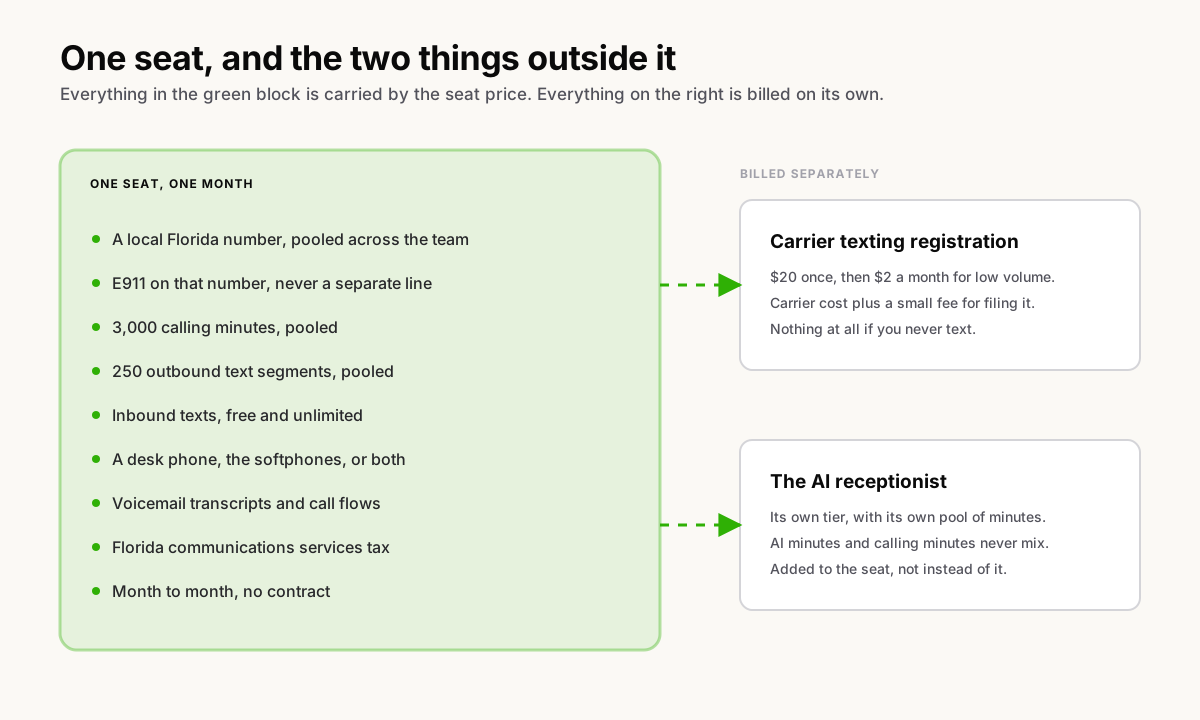
One seat is one person with a phone, not one device. The same seat covers them at the desk, on the laptop and on the mobile at once. Here is what is in it:
- A local phone number — 813, 727, or any Florida area code. One per seat, and the allowance is pooled across the whole organisation rather than pinned to a person.
- E911 emergency service on that number, included per number, never a separate line.
- 3,000 calling minutes, pooled across the whole team.
- 250 outbound text segments, also pooled. Texts people send you are free and unlimited, and always will be.
- A desk phone, shipped pre-configured, or the softphone in your browser, on your computer and on your mobile. Or both.
- Voicemail with transcripts, delivered to email.
- Call flows — menus, business hours, ring groups, hold music, after-hours routing.
- Month to month. No contract, no term, no cancellation schedule.
Pooled is the word doing the work in that list. A four-seat shop has one 12,000-minute pool and one 1,000-segment pool, and it does not matter which seat spends them. The owner who is on the phone all day is covered by the two people who are not.
The charges that are not inside it
Five things can add to that bill. I would rather name all five here than have you meet one on an invoice.
Carrier texting registration. US carriers require any business texting from a normal ten-digit number to register the business and the kind of messages it sends. It costs $20 once — $5 to register the business, $15 for the campaign review — and then $2 a month on the low-volume registration, which is what almost every small business needs. Higher-volume use cases are $10.50 a month instead. That is carrier cost plus a small fee for running the registration for you, and it sits outside the seat price because the carriers charge it, every provider in the country pays it, and you only owe it if you decide to text. If a campaign is rejected, resubmitting is a new $15 review, which is why the wizard is fussy about getting the legal name and the sample messages right the first time. Nothing is charged until you choose to register, and phone service works perfectly well if you never do.
The AI receptionist. It is a separate add-on with its own pool of minutes, in three tiers: Starter at $49 a month with 200 AI minutes and 45 cents a minute past them, Growth at $149 with 400 minutes and 40 cents, Pro at $349 with 1,000 minutes and 35 cents. AI minutes never come out of your calling pool and calling minutes never come out of the AI pool. The phone system underneath it is still a seat, so the receptionist is an addition to the bill, not a replacement for part of it.
Usage past the pools. Calling past your pooled minutes is 3 cents a minute. Texts past your pooled segments are 2 cents a segment. Unlike the seat price, these are rates plus applicable tax, and the running total is visible in your account on any day of the month rather than at the end of it.
Extra phone numbers. One per seat is included and pooled. Each number beyond the allowance is $1 a month.
International calling. Off by default. Turn it on and every international minute is one flat rate anywhere, 15 cents a minute, billed separately from the first minute rather than out of your US and Canada pool.
A worked month, for a three-seat shop
Three seats is a common shape: an owner, an office manager and one more phone. That account has a 9,000-minute pool, a 750-segment pool and three numbers.
| Line | Amount |
|---|---|
| 3 seats at $30 | $90.00 |
| Everything else | — |
| Monthly total | $90.00 |
In prose, because the audio player skips tables: three seats at thirty dollars is ninety dollars, and if the shop stays inside its pools that is the entire invoice. There is no tax line, no 911 line and no number rental, and there is no zero-dollar line confirming it either — a line worth nothing never gets added, and the absence is the confirmation.
Now the same shop decides to text customers and turns on the entry AI tier:
| Line | Amount |
|---|---|
| 3 seats at $30 | $90.00 |
| Texting campaign, low volume | $2.00 |
| AI receptionist, Starter | $49.00 |
| Monthly total | $141.00 |
| Texting registration, first month only | $20.00 |
Again in prose: ninety dollars of seats, two dollars for the monthly texting campaign fee and forty-nine for the Starter AI tier comes to a hundred and forty-one a month, plus a one-time twenty dollars for the registration in the first month only. If that shop then sent nine hundred texts in a month, it would be a hundred and fifty past its pool at two cents each, which is three dollars.
One tax note on those tables, and it is the only one the rate card supports me making: the seat price includes Florida communications services tax, and usage past your pool is billed at the listed rate plus applicable tax.
What moves this bill, and what does not
The bill moves when your seat count changes, when you change AI tier, when you go past a pool, when you add a number beyond the allowance, when you turn on international, or when you register for texting. Six things, all of them decisions you make rather than things that happen to you.
The bill does not move because you took a lot of calls inside the pool, because customers sent you a lot of texts, because you used the desk phone instead of the app, or because you moved to a Florida jurisdiction with a higher local tax rate. The seat price is one published figure and it is the same figure everywhere in the state.
Where this stops being tidy
Two limits worth stating. The pools are a fair-use allowance rather than an unlimited plan, so a business that genuinely makes thousands of minutes of outbound calls per seat is going to see overage, and should ask me for the arithmetic before signing rather than after. And the tables above are what the rate card said on the day this was written. Prices move. The page is generated from the billing rows, so the rate card is right even when this post has gone stale — if the two ever disagree, believe the rate card.
Check any of it yourself
The pricing page reads the same rows as your invoice, so nothing on it can quote a figure the bill would contradict. The mechanics have their own articles: what counts as a seat, how minutes work, and how texting is billed. Inside the product, your Billing page shows live meters for the calling pool, the text pool and the AI pool, so you can see where you are standing in the middle of the month rather than at the end of it.
If you want the version of this with your own seat count in it, that is a half-hour conversation with me and there is nothing to quote at the end of it. Book a time.
Got a topic you want covered? Email hello@heyquad.com.