
 David Hacker
Most Florida small-business hurricane plans cover the building, the stock and the staff. Almost none of them cover the phone. Then the power goes out for four days, the number on the sign rings into nothing, and customers call the next name on the list — which is the part of the storm that costs money after the wind stops.
This is the short version of what to set up, and it is worth doing in the spring rather than the week a cone shows up on the news.
What actually breaks
Two things, and neither is the thing people expect.
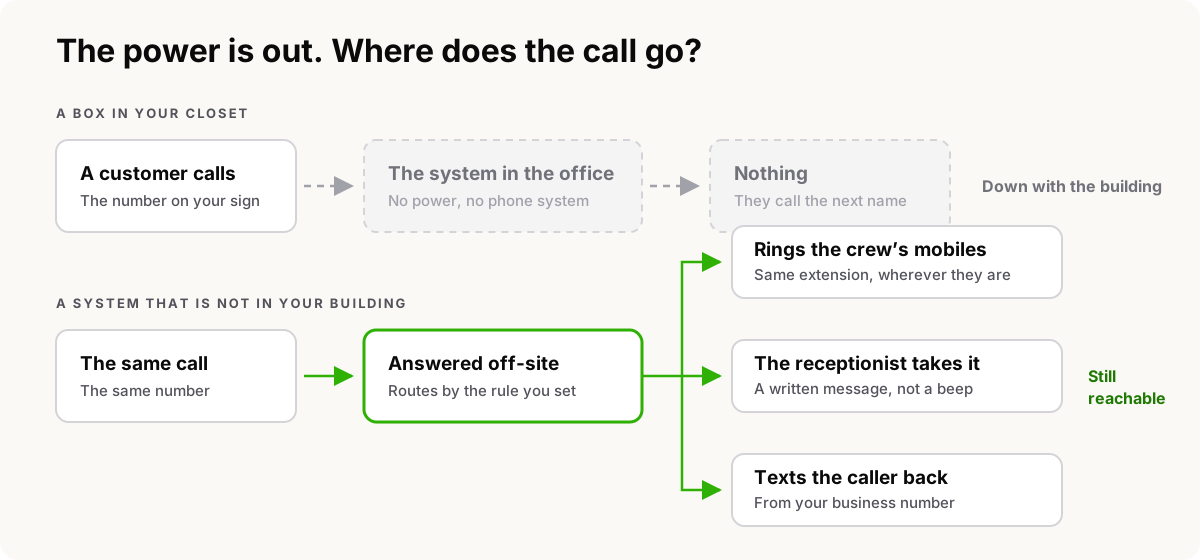
The first is a phone system that lives in your building. If there is a box in a closet or a rack behind the front desk, it is on your power and your internet, and it goes down with both. A generator keeps the lights on and the box needs the internet too, which is usually the thing that comes back last.
The second is subtler and catches more people: the plan that requires you to be in the office to execute it. Forwarding you set from a desk phone. Voicemail greetings you change by walking to a handset. An answering service you activate through a portal on the office computer. Every one of those is fine right up to the moment the building is dark, flooded or on the wrong side of a closed bridge.
Four things to set up before the season
1. Get the phone system out of the building
If your system is hosted, calls arrive at the carrier and are handed to software running in a data centre, not to a device on your desk. The office losing power stops being a phone event. This is the single change that does most of the work, and it is worth confirming rather than assuming — plenty of "cloud" installs still depend on an on-site box for routing.
2. Write the storm path before you need it
Decide now what should happen to a call when nobody is at a desk, and build it as a route you can switch on from your phone. Three patterns cover almost every business:
- Ring the mobiles. The same extension that rings at the desk rings on the phone in a pocket, wherever that pocket is.
- Let the receptionist take it. Calls are answered on the first ring, the caller is told plainly what is going on, and you get a written message instead of a voicemail nobody is checking.
- Announce and route. A recorded line that says what is actually true — closed today, crews out tomorrow, emergencies to this number — with anything urgent still reaching a human.
The important part is not which one you pick. It is that switching to it takes one tap from a phone, and does not require the building.
3. Put the softphone on everyone's phone now
Installing an app and logging in is a five-minute job on a normal Tuesday and an impossible one during an evacuation. Do it in the spring, make one test call from it, and leave it there. It also means your team never hands out a personal mobile number to a customer during a crisis, which is a number you will still be getting calls on in January.
4. Fix your 911 address, and know what it does not do
A phone that can be answered from anywhere has to be told where it is, because emergency dispatch cannot work it out. Every number carries an address for 911, and that address is where help gets sent — not where you are holding the phone.
That matters twice during a storm. Once because a wrong address on file is the worst possible thing to discover during an emergency, and once because evacuating does not move it. If you are answering business calls from a hotel in Ocala and you dial 911 from the softphone, dispatch may see the office address unless you have updated it.
Texting is the channel that works when calling does not
When a lot of people in one area pick up their phones at once, voice calls are the first thing to degrade — a voice call needs a circuit held open for its whole duration, while a text is a small packet that queues and retries until it lands. That is why a text often goes through in the hours after a storm when a call will not connect.
Which means the useful thing to be able to do is send one. Not a mass marketing blast — a real message to the customers with work booked this week: we are closed today, your Thursday appointment is moving, call this number if it is an emergency. If those people can reply to that text and reach you, even better.
Two practical notes. Business texting from a normal ten-digit number requires a one-time carrier registration, and it takes days to weeks to clear, so it is not something you start during the storm — get registered in the spring. And make sure the replies land somewhere a human is looking, because a text customers cannot answer is a broadcast, not a conversation.
The week of the storm
| When | What to do |
|---|---|
| Cone appears | Confirm who is on call, check the mobile app works on every phone |
| Two days out | Switch the routing to the storm path, text customers with work booked |
| During | Nothing. It already routes where you told it to |
| After | Switch back, work the messages that came in, call the bookings you moved |
In prose, because tables are skipped by the audio player: when the cone appears, confirm who is on call and check the app on every phone. Two days out, switch to the storm routing and text the customers who have work booked. During the storm there is nothing to do, because the routing already happened. Afterwards, switch back and work through the messages.
What none of this fixes
Being honest about the edges, because a plan that oversells itself is worse than no plan.
A hosted phone system keeps routing calls when your building is dark. It does not give your team internet. If a crew member has no cell signal and no power, their softphone will not ring either — the call falls through to the next person in the rule, which is exactly why the rule should have more than one person in it.
It does not give you a generator, it does not make the roads passable, and it will not answer a question your business has not taught it to answer. What it does is make sure the call arrives somewhere a human eventually reads it, instead of arriving nowhere.
Where to start
If your phone system is a box in a closet, that is the thing to change, and the good news is that porting your number is invisible to your customers — the old line keeps ringing until the new one takes over.
If you want to talk through what your storm routing should look like for your particular business, that conversation is free and it is with me. Book a time, or read how the routing works for HVAC, home services and the other businesses we build for.
Got a topic you want covered? Email hello@heyquad.com.