
 David Hacker
Six questions decide whether a business phone system is right for you, and none of them appears on a vendor's feature comparison chart. Here they are, with the answers I would want if I were the one buying — including the places where the honest answer is not us.
What you are actually buying
Strip the feature list away and a business phone system is three things: a number, the thing that answers it, and the thing it rings.
The number is the one on your van, your sign and every invoice you have ever sent. The thing that answers it is software — a menu, a schedule, a queue, an AI receptionist, or just a rule that says ring these four people. The thing it rings is a desk phone, an app on a laptop, an app in a pocket, or all three.
Everything else is a feature. Voicemail transcription, call recording, hold music, analytics dashboards, video meetings, an auto attendant with nine options — those are real, and one or two of them probably matter to you, but they are not what the decision turns on. Every vendor in this market has them, and comparing them is how a buying decision becomes a spreadsheet nobody reads twice.
I spent a decade engineering contact centres for Fortune 500 companies, which meant deploying thousands of seats and then living with forty-odd platforms after the sales cycle ended. The thing I took away from that is that the surprise is never in the demo. It is in the second invoice, in the sentence under the advertised price, and in what happens on the first day something breaks.
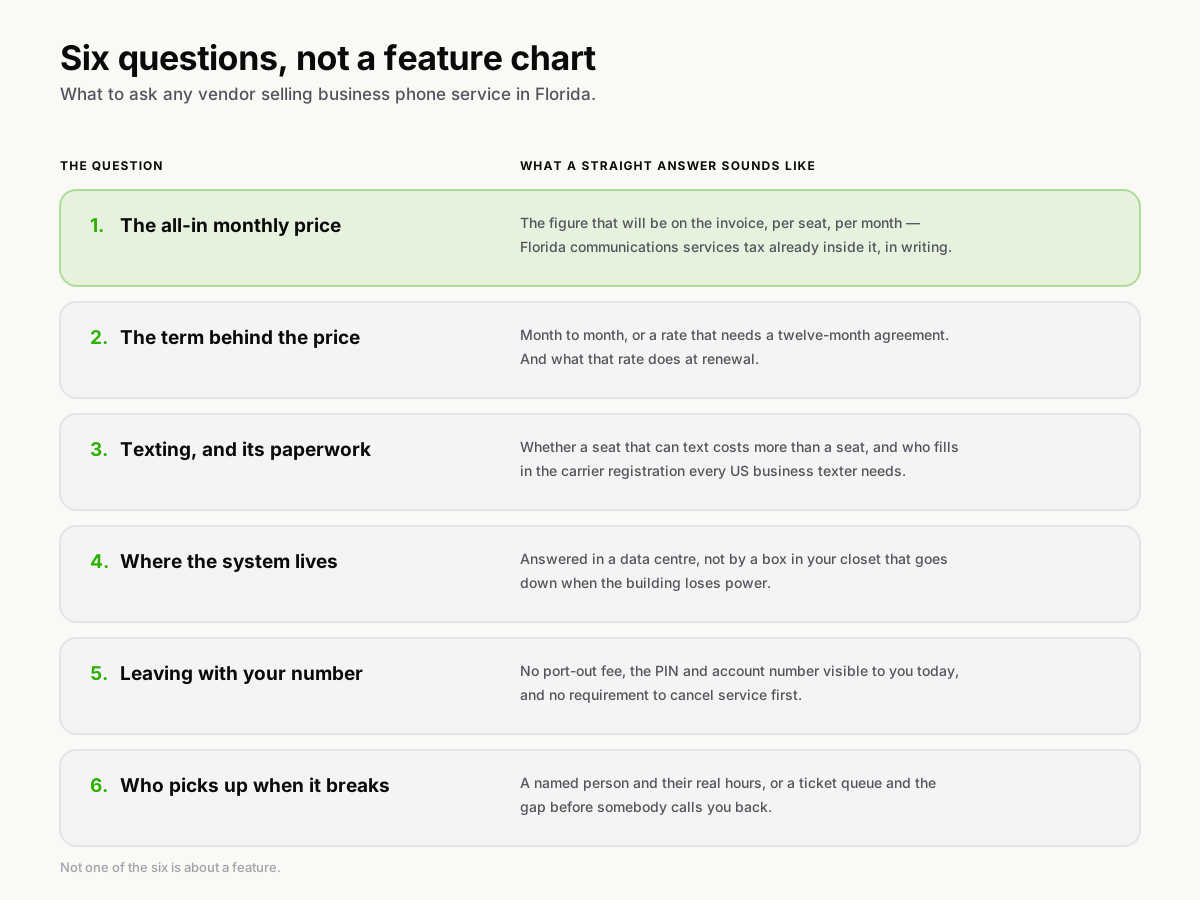
The six questions
1. What is the all-in monthly price per seat, with Florida tax in it?
Ask for the figure that will appear on the invoice, per seat, per month, and ask for it in writing before you sign anything.
Florida charges a communications services tax on phone service. The state portion is 7.44%, and on top of that sits a local rate set by the taxing jurisdiction of your service address. Combined, the rate runs from 7.74% to 15.14% depending on where your office is. In Tampa it is 13.46%. That is applied to the advertised price, not contained in it, at every national provider I have checked.
Their own pages say so, in their own words. Ooma: "Unlimited calling is included with Ooma Office subscription fees but monthly taxes and fees still apply due to federal regulations." Quo: "Applicable taxes and fees added at checkout." RingCentral spells out the list: "Other taxes and fees such as the Federal Universal Service Recovery Fee, E911 Service Fee, Compliance and Administrative Cost Recovery Fee, 911 Fee, and State and Local Taxes, may apply." Nextiva's pricing page says nothing about tax at all. Every one of those was read at the provider's own page on 8 September 2026.
None of that is dishonest. It is how the industry has always quoted, and the tax genuinely is not theirs to keep. But it means the advertised number is not the number, and in Florida the gap is wider than most buyers expect. I am not going to run their arithmetic in a blog post, because a figure I calculate here goes stale the moment somebody reprices. The comparison pages do it properly, with the working shown and the date each figure was read, and the tax page explains where the percentage comes from.
The question is simpler than the arithmetic. A vendor who will put an all-in number in writing has already done the sum. One who will not is asking you to find out on your first bill.
Our own answer, for what it is worth: one price per seat with Florida's communications services tax already inside it, and no separate tax line on the invoice. That is on the pricing page rather than behind a call.
2. What does the advertised price require you to sign?
The number on the pricing page and the number you pay are often separated by a contract term, and the term is usually in smaller type.
Nextiva's page states the condition exactly: "Eligibility for annual Small Business pricing: new small business customers with 1–100 employees signing a paid 12-month or longer minimum term agreement." Read at their page on 8 September 2026. That is a real offer and a defensible one — a year of certainty is worth a discount to them, and it may be worth one to you. It is only a problem if you compared their annual figure against somebody else's monthly figure and did not notice which was which.
So ask three things. Is this price month to month? What is the price if I pay monthly instead of prepaying a year? And what happens at renewal — does the rate hold, or does it revert?
Ours is month to month. If it stops being worth what it costs, you stop paying it, and I would rather find that out than have it hidden behind a term.
3. Does texting cost extra, and who files the registration?
Business texting has two separate costs, and vendors tend to disclose one of them.
The first is whether texting is in the seat price at all. RingCentral's shared-text inbox with templates and compliance tools is the Business SMS Booster add-on at $25 per user a month, on top of a RingEX seat whose price their pricing page no longer publishes — every tier reads "Contact us for pricing". Both read at their page on 8 September 2026. Ooma's entry tier has no texting at all; it starts on the middle tier. So ask what a seat that can actually text costs, not what a seat costs.
The second cost is registration, and it exists everywhere. Since 2021 the US carriers have required any business texting from a normal ten-digit number to register the business and the kind of messages it sends. The programme is called A2P 10DLC. An unregistered number can still send a text, and it will look sent on your screen, and the carrier will drop it before it reaches the phone. That is not a vendor policy. It is the same for every provider in the country, including this one.
What differs is disclosure and who does the paperwork. Quo publishes theirs plainly: $19.50 one-time for carrier review and setup, then $1.50 to $3 a month, described as a third-party Campaign Registry charge. Ooma, Nextiva and RingCentral publish no registration fee at all on the pages I read. Ours is $20 once and $2 a month on the low-volume registration most small businesses need, which is carrier cost plus a small fee for running it, and I fill in the forms myself. Ask any vendor both halves: what does registration cost, and am I filling it in or are you?
4. Where does the system actually live?
If there is a box in a closet or a rack behind the front desk, your phone system is on your power and your internet, and it goes down with both. A generator keeps the lights on; the box still needs the internet, which is usually the thing that comes back last.
This deserves a plain question because "cloud" is a word that survives a lot of installs it should not. Ask where the call is answered when your building has no power. If the answer involves anything in your building, that is an on-premises system with a hosted app bolted to the side of it.
I wrote a whole piece on this one, because in Florida it is not hypothetical: your hurricane plan has a phone problem.
5. What happens to my number when I leave?
Ask this before you sign, not after you are unhappy. The answer tells you how a vendor thinks about customers who want out.
Keeping your number when you switch providers is a federal right, and a carrier is not allowed to hold your number over an unpaid balance. Knowing that, ask three specific things. Is there a fee to port out? Where do I find my account number and my port-out PIN — can I look at them today, in the app, without calling anybody? And do I have to cancel service first? The correct answer to the last one is no, and emphatically so: a cancelled line is not portable, so cancelling early is the most reliable way to get your own port rejected.
Ours sit on a Security card on each number's page, and the article explaining them is public, because a vendor that makes leaving difficult is telling you it expects to need to. The same mechanics run in reverse when you arrive, and I wrote those up separately: how to move your number without going dark.
6. Who picks up when it breaks?
Not "is there support" — there is always support. Ask who, by name or by role, and when.
There are two honest models here and they are genuinely different. A national provider with a support organisation has somebody awake at three in the morning, a documented escalation path, and a replacement for the person who leaves. A one-person company has the person who built the thing answering the phone, which usually means the first reply is the fix rather than a triage question. What a one-person company does not have is three in the morning.
Both are defensible, and which one suits you depends on what your business does at night. What is not defensible is a vendor who answers this question with the words "24/7" and a link to a ticket form. Ask what happens between the ticket and the call back, and how long that gap usually runs.
When I am the wrong answer
Four cases, and I would rather put them here than discover them on a call.
You are not in Florida. We sell in Florida only, for now. The price is built around Florida's communications services tax, and doing that properly is a per-state piece of work rather than a checkbox. There is a waitlist, and which state comes next is decided by where the demand on it actually is, not by a date I would be guessing at.
You are one person who wants a second number on your cell and never texts customers. You do not need a phone system. You need an app, and the fifteen-to-nineteen-dollar tier at any of the app-first providers will do that job better and cheaper than I will. Buying a seat with pooled minutes, pooled texts and a desk phone package to get a second number is paying for a building you are not going to enter.
You have twenty agents, a formal queue and Salesforce at the centre of everything. That is a contact centre, and the platforms built for one are better at it than we are. RingCentral's integration catalogue and Nextiva's contact-centre tiers do things we do not do and are not trying to do. That is written on our own comparison pages as well, because a comparison with no honest concession in it is an advert.
You need a vendor with a compliance department. We do not have SOC 2 and are not in the process of getting it. If your procurement requires a certification, that is a real requirement and we do not meet it today.
Where to start
Take the six questions to whoever you are already talking to. They work on me as well as on anybody else, and if a vendor gets impatient at question one, you have learned something for free.
If you want to walk through your own situation — how calls come in now, what should happen at 6pm on a Friday, what it would actually cost — that conversation is with me, it takes half an hour, and there is nothing to quote at the end of it because the price is already published. Book a time.
Got a topic you want covered? Email hello@heyquad.com.
Sources. Competitor wording quoted above was read at each provider's own pricing page on 8 September 2026: ooma.com small business phone systems, quo.com pricing, nextiva.com pricing, and RingCentral's plans and pricing page. Florida communications services tax rates come from the Department of Revenue's own jurisdiction rate table; the derivation is shown on the tax page. A2P 10DLC is a US carrier programme run through The Campaign Registry, not a Hey Quad requirement.