
 David Hacker
Almost nobody changes phone providers casually. They change because something is broken, and then they stop, because the number on the truck and the sign and nine years of invoices is not a thing you gamble with.
So here is the part you want first. The old line keeps ringing the entire time. The number moves on a date the two carriers agree between themselves, the switch itself takes minutes, and until that minute every call arrives exactly where it arrives today.
What porting actually is
Porting means moving a phone number from one carrier to another. The number is yours, not your carrier's. Under the FCC's number-portability rules your provider has to release it when you ask, and it is not allowed to keep the number because there is a balance in dispute.
What it can do is charge a porting fee and hold you to whatever your contract says about leaving, so read that page first — it is the one cost of switching nobody warns you about. And you never call your old carrier to begin this. You place the request with the new provider, and they file it with the old one.
Where the one to four weeks goes
A port normally takes one to four weeks, and almost all of that is your current carrier reading your request. They are checking the details you gave against the record they hold, line by line, and there is no queue-jumping that. I file the paperwork, I chase it, and then I wait with you.
The request moves through four states, and the page in your account shows which one it is in.
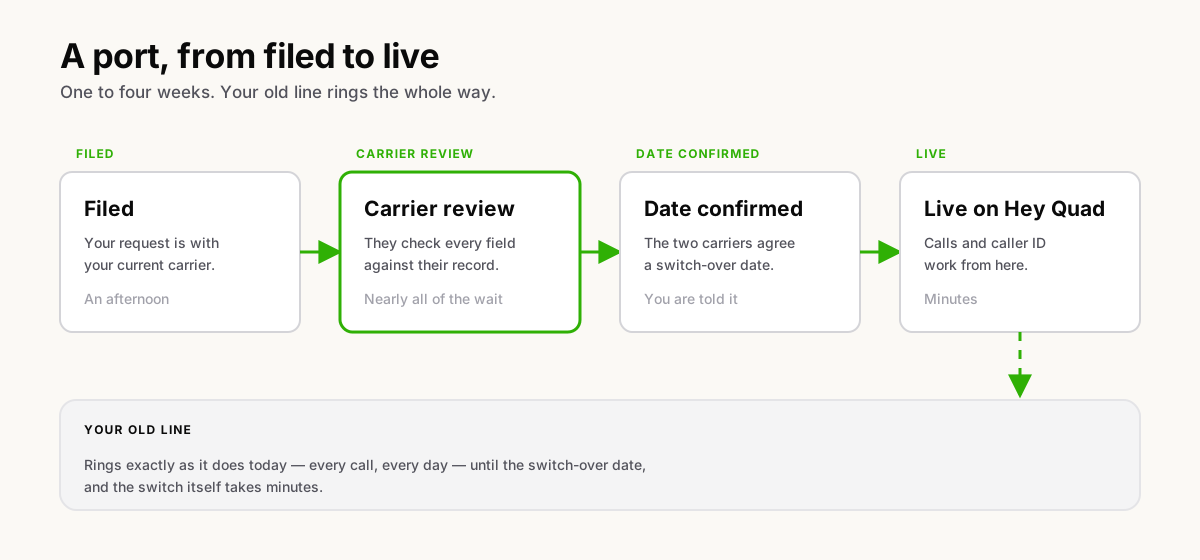
Before any of that, there is a two-second check worth doing first. On Phone numbers, then Port in, there is a button that asks the carrier network whether your numbers can move at all, and answers while you are looking at it. A number that cannot be ported is far cheaper to find out about now than three weeks into paperwork.
Two numbers commonly cannot move. Toll-free numbers — 800, 833, 844, 855, 866, 877 and 888 — transfer by a completely different process called a RespOrg change, which the self-serve form does not handle; email support and we file it for you. And if you are moving the business to a different part of the country, a local number may simply not travel with you, because it belongs to a geography as much as to you.
The paperwork, and why every field has to match the bill
Have your latest bill from your current carrier in front of you. Every field below has to match their record exactly — not what you call the business, not what is on the sign. A mismatch is the most common reason a port is rejected, by a distance.
| Field | Where to find it |
|---|---|
| Business or account-holder name | The name the bill is addressed to |
| Authorized name | Whoever is allowed to make changes on the account |
| Billing telephone number | The main number the account is billed under |
| Account number | Usually near the top of the bill |
| PIN or passcode | Your carrier's account PIN, if they use one |
| Service address | The street address on the account, in full |
Read aloud, that is six fields: the account-holder name exactly as the bill prints it, the authorized person on the account, the billing telephone number, the account number, the account PIN if your carrier uses one, and the full service address. Two of those catch people out. The billing telephone number is often not the number you are moving — it is the main line the whole account hangs off. And "Acme Inc" and "Acme, Inc." are two different businesses as far as a carrier's matching software is concerned.
You also upload two documents: a Letter of Authorization, which is signed permission to move the number and which we generate for you, and a bill from the last thirty days showing the numbers and the account details above. Your carrier will not accept the request without both, so the form asks for them before it lets you file.
The three ways a port dies
You cancel your old service early. This is the big one. A cancelled line is not portable, so the request is rejected and you are now trying to get back a number that is no longer yours. The FCC's own consumer guidance leads with the same instruction: do not terminate service with your existing company before the new service is in place. Keep paying your old carrier until the request reads live.
Something does not match. A name, an address, a billing number. This is the ordinary case and it is not a disaster: the request comes back marked "Needs a correction" with the carrier's reason in plain language, you fix the field, you resubmit, and the same request goes back. Nothing is lost and you do not start over.
A toll-free number is filed as if it were a local one. Different process, as above. Send those to support instead of the form.
Forward first, port later
Here is the option almost nobody mentions, and it is the one I would start with.
You do not have to move the number to use any of this. Your existing carrier can forward calls to a Hey Quad number, where the AI receptionist answers them, and your current service, phones and bill stay exactly as they are. Conditional forwarding is the gentle version: your phone rings first the way it always has, and only a call you are too busy to take or do not answer forwards on. On most carriers that is star 71, and star 73 turns it off again. Codes vary by carrier and plan, and the help article lists them for Verizon, AT&T, T-Mobile and Spectrum specifically.
Plenty of businesses should live like that for a few weeks, watch what the receptionist does with their actual calls, and only then decide whether to move the number. Forwarding first makes a later port no harder.
Switch day, and the four things to check
The switch happens on the agreed date, usually without you noticing. When the request reads live, do four things in about five minutes.
Place a call out and check the number your caller ID shows. Have someone call you in and confirm it rings where you meant it to ring. Open the number's emergency settings and confirm the 911 address is your real street address, because that is where help gets sent and it does not follow the phone around — here is how. Then, and only then, cancel your old service.
Texting is the one thing that does not switch on with the number. Business texting from a ten-digit number needs its own carrier registration, which takes days to weeks and is separate from the port. Calls work immediately; texts work once that registration clears.
What I cannot promise you
A date, until the two carriers have agreed one. Anyone who gives you a firm porting date before the losing carrier has confirmed it is guessing.
That a first submission always clears. Rejections are common, almost always a paperwork mismatch, and they cost days rather than the whole port — but I am not going to pretend they do not happen.
That your old carrier will not charge you to leave, or that a local number can follow you to another state. Neither is mine to decide. And forwarding, if you take that route, only redirects incoming calls — outbound, 911 and any texting on that line stay with your existing carrier.
Leaving is the same deal in reverse
Ask this of anyone you are about to hand your number to, so here is my answer first. We do not block, delay or charge for a port-out, and we will not hold a number over an unpaid balance. Your new carrier will ask for an account number and a port-out PIN, and both live on the number's Security card — see moving your numbers away.
Set that PIN early. It is not there to keep your number in. It is there to stop somebody else moving it out without your say-so, which is an old and still-common fraud.
Where to start
If the system you are leaving is a box in your building, the port is the second thing to fix and getting the system out of the building is the first — that argument is in your hurricane plan has a phone problem.
If you want someone to read your bill and tell you whether your numbers will move cleanly, that is a fifteen-minute conversation and it is with me. Book a time.
Got a topic you want covered? Email hello@heyquad.com.
Sources for the rules outside this site: the FCC consumer guide, Porting: Keeping Your Phone Number When You Change Providers.