
 David Hacker
I sell phone service to Florida businesses and nowhere else. Not because the software stops at the state line, but because being someone's phone company means dealing with that state's communications tax, and doing that properly in one state beats doing it badly in fifty.
That is the whole answer. The rest of this is what it means in practice, what it costs you if you are reading this from Georgia, and what it does not mean.
The reason is a tax, and it is per-address
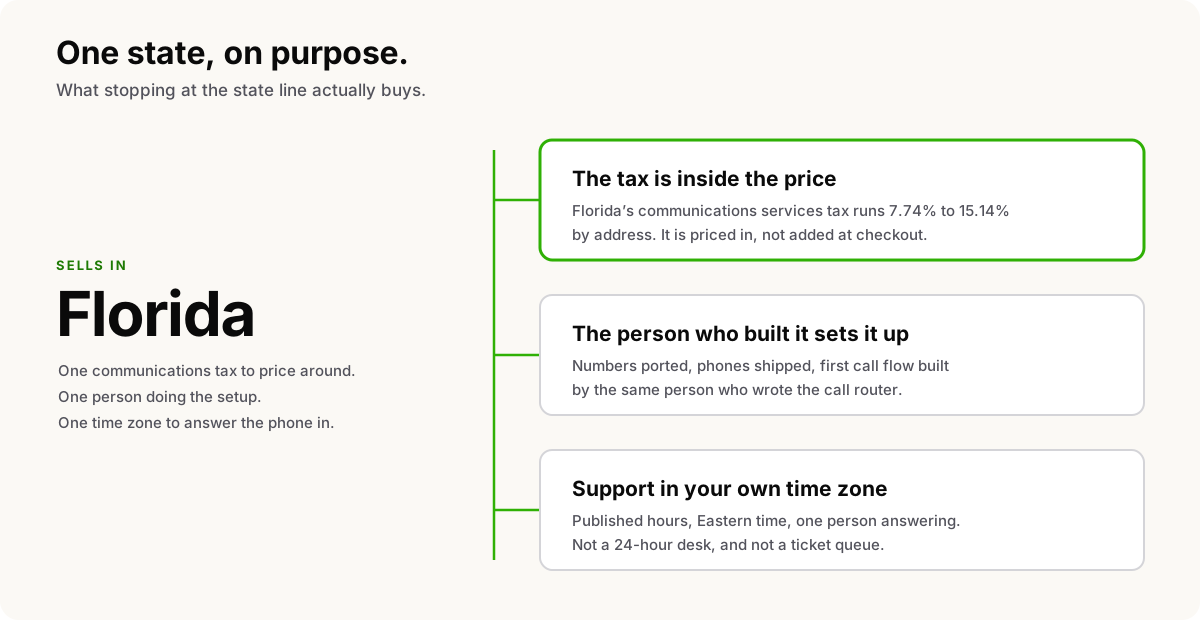
Florida charges a communications services tax on phone service. It is not one rate. There is a state portion, and then a local portion set by the address the service is billed to, which is why the combined rate runs from 7.74% to 15.14% depending on where in Florida you sit. In Tampa it lands at 13.46%.
Every national provider handles that the same way: advertise a number, add the tax at checkout, let the first invoice be the surprise. I handle it by building the tax into the price I publish, so the figure on the pricing page is the figure on the bill. The arithmetic is on its own page if you want to check mine.
That only works when I know exactly which jurisdictions I am pricing for. A second state is not a second column in a spreadsheet. It is a different tax with a different structure, its own registration, its own return, its own deadline and its own local rates by address. Do that across five states while also running everything else and either the flat price stops being flat or the filings stop being on time. Neither is a thing I want to explain to you afterwards.
What "done properly" means
Three things, and they are why the constraint is worth it.
A price that survives the tax. One number per seat, per month, with Florida's tax already inside it. No regulatory recovery fee, because I do not have one.
The person who built it sets it up. I port your number, ship the desk phones, build the first call flow and answer when you ring about it. There is no SDR layer and no onboarding queue, because there is nobody else here. The company page is short for the same reason.
Support in your own time zone. Published hours, Eastern, one person. That is a real limit and I would rather you read it here than discover it at two in the morning: this is not a 24-hour desk.
What I did before this
I spent the last decade engineering contact centers for Fortune 500 companies. Thousands of seats, dozens of platforms, the kind of phone system that arrives with a project manager attached. Those numbers belong to those companies, not to this one.
What I took away from it is a fairly narrow opinion. Almost everything a large contact center does well is available to a five-person shop, and almost none of it is sold to them. What gets sold to them instead is a hand-me-down box in a closet, or a consumer app with a business sticker on it. The routing, the queues, the after-hours rules, the message that actually reaches somebody: none of that is hard technology any more. It is just never packaged for a business that answers its own phone.
So that is what I am building, for the businesses I can actually reach.
What Florida-only costs, honestly
It costs me the easy version of growth. Turning down someone who wants to buy is a strange thing to do on purpose, and I do it.
It costs you nothing if you are in Florida, and it costs you the whole product if you are not. There is no soft version of that. What I can do is take your details, and the form asks for three things: your state, your business, and how many desks you would need. The desks are the point. The next state I open is decided by where the demand actually is, counted in phones rather than in email addresses.
I am not naming a state or a date, because I do not have one and a guess would just be marketing. The list decides.
Florida-only does not mean Tampa-only
I am in Lutz, in Tampa Bay, which is why I can turn up in person around the bay with a box of desk phones. That is where I am. It is not where the service area ends.
There are three metro pages on this site because there is genuinely something different to say about those three markets. Everywhere else in Florida gets the same product, the same price and the same setup call, and the state page lists the area codes I can put on your business instead of a page that swaps a city name into a paragraph you have already read. Jacksonville, Pensacola, Naples, Ocala, the Keys: same phones, same bill.
Where to start
If you are in Florida and you want to talk through what your phones should actually do, that conversation is free and it is with me. Book a time, or read what it costs first.
If you are not in Florida, use the same page and tell me your state anyway. It goes on the list, and the list is what decides where I go next.
Got a topic you want covered? Email hello@heyquad.com.
Sources: Florida communications services tax rates from the Florida Department of Revenue's communications services tax page and its jurisdiction rate table, verified 8 September 2026. The workings are shown on the tax page.